

We are nationwide leaders in airport pavement management systems.

Pavements represent some of the biggest infrastructure investments at any airport. At APTech, we understand the importance of maintaining good pavement conditions from two vitally important perspectives — keeping runways, taxiways, and aprons safe for aircraft operations, and doing so in the most cost-efficient manner.
Our approach to the airport pavement management process is informed by our decades of experience working side-by-side with our clients to understand what is most important to them and achieve their pavement goals. We provide innovative and workable solutions to meet our client’s needs, taking into consideration budget uncertainties, busy schedules, and tight timelines.
Airport Pavement Management Systems
Let APTech’s highly trained airport pavement specialists use their knowledge and experience to ensure the success of your next system implementation or update. Our pavement management services include:
Pavement Condition Index (PCI) Inspections and Visual Evaluations
The PCI procedure is the gold standard in the U.S. aviation industry. Dozens of our engineering staff members are extensively trained in this methodology and collectively have performed more than 7,400 airport PCI evaluations.
Other visual evaluation methods include distress mapping and automated data collection using our Enhanced Data Gathering Equipment (EDGE).

APTech’s heavy-weight falling weight deflectometer.
Pavement Testing and Structural Evaluations
Our pavement testing capabilities include falling weight deflectometer (FWD) testing, dynamic cone penetrometer (DCP) testing, coring, structural remaining life analysis, structural deficiency calculations, Pavement Classification Rating (PCR) calculations, load transfer efficiency testing, and corner slab support / void detection testing.
PAVER Database Updates and Customization and GIS Integration
Our expertise with PAVER software implementations, updates, and customizations is unmatched. Several of our staff members have even served as advanced beta testers for the latest PAVER software updates.
Maintenance and Rehabilitation (M&R) Planning
All pavement — even the most well-designed and constructed — deteriorates over time due to factors like traffic loads, weather, and environment. Regular and often low-cost M&R activities, like crack sealing and joint sealing, can help slow the deterioration of your pavement. APTech’s engineers help determine your M&R needs and prioritize projects to get the most bang for your buck.
Pavement Design
APTech’s engineers use the latest tools and resources to inform their pavement designs, considering the trade-offs between flexible and rigid pavements, traffic loads, environment factors, and other considerations.
Web-Based Data Visualization Tools

We collect a lot of data about pavement, and it’s often a challenge for agencies to harness that data in a concise, effective manner to communicate to stakeholders. Enter APTech’s Interactive Data Exchange Application, or IDEA. This web-based data visualization tool takes all pavement data, whether collected by us or someone else, and synthesizes it into an interactive platform that’s easy to use, visual, and available to stakeholders at any time. IDEA functionality is also compliant with Section 508 of the American Rehabilitation Act, a requirement for most state and federal agencies.
Use the map below to explore some of the IDEAs we’ve developed for our state aviation clients.
Training
Customized training is a standard part of our pavement management system projects, covering courses on the PCI procedure, PAVER software, and M&R techniques—putting the tools you need to succeed into the hands of your agency’s staff.
What our clients say …
“The state of Louisiana is very pleased with the final product that [APTech] delivered to our office and to the airport system throughout our state. The level of professionalism and attention to detail contributed to the overall success of this project.”
Recent Airport Pavement Management Projects

The Houston Airport System (HAS) selected APTech, working as a subcontractor, to complete several comprehensive pavement condition assessments as part of its asset management strategy to maintain its pavement infrastructure. APTech was chosen for this work due to our experience performing the airport pavement management system (APMS) update in 2014. This project involved concurrent efforts at three airports maintained by HAS (Houston George Bush Intercontinental Airport, Houston William P. Hobby Airport, and Ellington Field) and required APTech to manage large volumes of accurate data and integrate them into the HAS PAVER databases.
This project entailed leading APMS updates at all three HAS airports. To begin, APTech performed a records review while updating the pavement inventory and network definition. APTech then collected pavement condition data by georeferencing each distress on runways, taxiways, and select aprons using tablet computers paired with GPS units. APTech staff filtered the collected distress data according to the ASTM D5340-20 PCI methodology prior to uploading into the PAVER database for each airport. APTech also performed FWD testing and analysis to assess structural integrity of the pavements and provided a runway grooving assessment. As part of this work, APTech also developed a capital improvement plan (CIP) and an infrastructure condition assessment using metrics established by HAS. APTech concluded this project by developing a final project report and providing HAS employees with PAVER training.
Because of APTech’s work, the HAS staff can now make asset management decisions across their pavement networks using geo-referenced data down to an individual slab-level. The collected information allowed HAS to easily retrieve the physical condition, remaining service life, and operational impact of each pavement asset throughout their airfield networks. Additionally, by geo-referencing each distress the maintenance work plans are based on actual locations and dimensions of work quantities. Due to HAS’ satisfaction with this project, APTech was recently awarded another contract as a subconsultant to incorporate the remaining aprons and shoulder pavements into their pavement management system.

In advance of the 2028 Olympics, Los Angeles World Airports (LAWA) is planning improvements for the North Airfield to enhance its airfield operational management and safety as part of the Los Angeles International Airport (LAX) Airfield Improvement Program (AIP). These affected areas include the exits and runway keel section of Runway 6L-24R and Runway 6R-24L. As part of the selected design team, Applied Pavement Technology, Inc. (APTech), as a subcontractor to HNTB Corporation (HNTB), provided pavement design services to develop multiple rehabilitation and new construction alternatives for the taxiways, along with shoulder and blast pad pavements and erosion control areas. APTech also performed structural testing to assess the structural remaining life of the Runway 6L-24R pavements.
APTech reviewed available geotechnical testing results and aircraft traffic data for the anticipated project locations and developed pavement design alternatives in accordance with FAA Advisory Circular 150/5320-6G, Airport Pavement Design and Evaluation, and using FAA’s FAARFIELD pavement design software. Geotechnical testing indicated a wide range of subgrade support conditions across the project area. Additionally, traffic demands varied by taxiway, with the high-speed exits having arrival aircraft (lighter weights). The design team worked with LAWA to determine appropriate aircraft traffic mixes and anticipated growth rates for the associated runways and taxiways. Both 20-year and 40-year designs were assessed. Based on the varying field conditions and anticipated traffic, a matrix of pavement cross sections was determined, with advantages and disadvantages provided for each alternative. APTech also conducted falling weight deflectometer (FWD) testing on Runway 6L-24R and analyzed the data to determine in place layer properties and to assess the structural remaining life using the FAA’s FAARFIELD software.
As part of this project, APTech offered customized solutions to fit LAWA’s needs. Pavement designs were selected to be cost-effective and meet traffic demands. APTech recommended concrete for the departure pavements (Runway 6R-24L and Taxiway E) and high-speed exit taxiways pavements (Taxiways W, V, U, and S), with the high-speed taxiway pavements being slightly thinner overall. Asphalt pavements were selected as more cost-effective alternatives in the non-traffic areas such as the shoulder, blast pad, and erosion control areas.
Based on the structural assessment of Runway 6L-24R, APTech determined that at least portions of the asphalt overlay would likely need to be replaced within about 5 years. The design team noted that unbonded areas determined through the evaluation are anticipated to show fatigue cracking from acting as thin layers under aircraft traffic loads, and APTech recommended they be removed and replaced. These improvements will enhance the safety of passengers and airport employees and ensure the airport will be able to handle the additional traffic anticipated for the Olympics.

Applied Pavement Technology, Inc. (APTech) worked as a subcontractor to update the PMP for the runways and taxiways at Charlotte Douglas International Airport (CLT). This project included approximately 20 million square feet of pavement and was built on a program previously completed in 2017 for CLT’s runway and taxiway pavements. Runway and taxiway shoulder pavements were incorporated into the PMP as part of this project, providing the client with more comprehensive information about their airfield pavements. The project was complemented by a Pavement Management Program (PMP) for apron pavements, completed by APTech in 2020.
This project consisted of multiple phases. The first phase focused on pavement analysis, which included reviewing relevant pavement maintenance and construction records, performing PCI inspections, conducting FWD testing, and developing a coring plan. On-site work was completed during nightly closures. APTech customized the PAVER database to determine the maintenance and rehabilitation (M&R) needs, which were used as a starting point for developing a 5-year capital improvement plan (CIP). Subsequent analysis consisted of calculating PCNs and PCRs, along with calculating structural remaining life of each aircraft-trafficked pavement section. APTech submitted a comprehensive project report and executive summary documenting the methodologies used, data collected, and results of the analysis for the runway and taxiway PMP update. APTech also participated in a series of meetings throughout the project to facilitate coordination and communication of results.
The second phase of this project included on-call pavement assessments as requested by CLT to determine the ability of certain pavement areas to accommodate aircraft operations outside of the typical aircraft fleet mix. The final phase consisted of performing annual (4 years in total) non-destructive testing on a sinusoidal longitudinal joint constructed along Taxiway M, analyzing the data to calculate the load transfer efficiency, assessing the relationship to or change from previous results, and providing the data to the Federal Aviation Administration’s William J. Hughes Technical Center as part of ongoing research.
APTech’s work on the PMP allowed CLT staff to manage their valuable runway and taxiway pavement infrastructure in an efficient, cost-effective manner, considering both functional and structural conditions. Results of this project brought engineering, planning, and maintenance staff together to continue improving their airfield pavement infrastructure.

APTech has provided pavement management, evaluation, and design services to the Kansas City Aviation Department (KCAD) for projects at Kansas City International Airport for more than 15 years. During our most contract, ongoing since 2020 as a subconsultant, APTech performed the 2021 and 2024 PMP updates, as well as airfield pavement evaluation and design projects for Runways 9-27 and 1L-19R and for Taxiways C and E. These services include PCI inspections, PAVER updates and analysis, FWD testing and analysis, PCN and PCR calculations.
PMP Update
In 2021, the KCAD partnered with the HNTB-APTech team to update to the airfield PMP. The project included over 23 million square feet of airfield pavement on runways, taxiways, and terminal apron pavements. The project also incorporated the overhaul base apron. APTech began this project by reviewing the construction records and updating the PAVER database and associated maps to reflect construction and rehabilitation work that had occurred since the previous update. APTech also led the pavement condition index (PCI) inspections (assisted by HNTB staff), identified maintenance and rehabilitation needs, developed a recommended capital improvement plan (CIP), and documented the results and recommendations in a project report and corresponding executive summary. The HNTB-APTech team are currently conducting the 2024 PMP Update. In addition to the tasks completed during the 2021 Update, the APTech team is also determining Pavement Condition Ratings (PCR) for runway pavements to comply with the FAA requirements.
Evaluation and Design Services
Based on needs identified in the PMP project, in 2022, APTech performed an evaluation and preliminary design for Runway 9-27. APTech began this project by performing falling-weight deflectometer (FWD) testing to conduct a structural analysis of the asphalt-surfaced pavement on the runway. APTech then developed a geotechnical testing plan based on initial review of the FWD data. APTech also assessed the PCN and PCR for this runway based on testing results and current traffic. The results of this analysis were used to develop a short- and long-term rehabilitation plan for this runway.
Also in 2022, APTech performed a structural analysis of the aging concrete pavement along Taxiway E, which was exhibiting durability cracking. APTech conducted FWD testing and provided an associated analysis while offering input into a geotechnical investigation. The results of this work led to pavement surface reconstruction recommendations.
In 2020, APTech performed pavement design services for the planned reconstruction of Runway 1L-19R, which serves as the airport’s primary runway. APTech began this project by reviewing available records, including data from a previously conducted preliminary evaluation. The APTech team then developed runway reconstruction design alternatives, performed a life-cycle cost analysis (LCCA), and created a detailed pavement design report. Following reconstruction of the runway, APTech also reviewed PCR calculations completed by HNTB.
In 2020, APTech also conducted an in-depth evaluation of Taxiway C (east of Runway 1R-19L) to develop a rehabilitation plan. This project involved reviewing design and construction plans, past pavement studies, and traffic details. APTech also performed FWD testing as part of the evaluation and developed pavement rehabilitation and reconstruction alternatives. The APTech team also created an LCCA of feasible alternatives to allow KCAD to determine the most cost-effective work approach. Following construction of a pavement overlay along a portion of Taxiway C, a B747 aircraft was improperly tugged across the pavement causing surface damage. To assess the extent of the surface damage, APTech partnered with TREKK, who took UAS-captured aerial images to better assess repair costs.
APTech’s work at KCI demonstrates our team’s ability to customize multiple projects to fit the unique needs of individual airports. This project also illustrates APTech’s experience with pavement management and evaluation projects within the FAA’s Central Region.

North Dakota’s aviation system was heavily impacted by investments in oil recovery starting in 2008. In some areas of the state, traffic levels increased by more than 70 percent annually, and most airports saw much larger and heavier aircraft in their operations. Together, these factors impacted the system’s condition and future needs and presented a serious challenge for state officials to manage their airport pavement infrastructure. To proactively address this need, in 2011, North Dakota Aeronautics Commission (NDAC) selected APTech, as a subconsultant, to update and enhance North Dakota's state airport pavement management system (APMS). NDAC reselected APTech in 2015, 2018, 2021, and most recently in 2023 to continue to update and improve their APMS.
APTech’s role in these projects included updating pavement inventory data, construction history information, and project mapping. APTech also collected pavement condition index (PCI) inspection data, completed a variety of condition analyses, and developed a five-year pavement needs analysis. During previous updates, APTech also performed non-destructive testing using our falling weight deflectometer (FWD) and calculated Pavement Classification Numbers (PCNs).
In 2022, the Federal Aviation Administration (FAA) updated pavement strength reporting guidance to align with those of the International Civil Aviation Organization (ICAO), causing reporting requirements to transition from the previous PCNs to Pavement Classification Ratings (PCRs). As part of the most recent update, APTech is calculating PCRs for runways servicing aircraft over 12,500 lbs at eight commercial service airports to comply with the updated pavement strength reporting guidelines.
As part of these updates, APTech has assisted in outreach activities related to the APMS in the form of focus group meetings and presentations at North Dakota’s annual airport conference. APTech also developed—and subsequently updated—its web-based interactive pavement management tool, IDEA, to enable the NDAC, airport managers, and other stakeholders to view project results online and modernize the way project information and results were disseminated.

In 1998, the Pennsylvania Bureau of Aviation (Bureau) selected APTech to implement a statewide airport pavement management system (APMS). Due to the agency’s satisfaction, APTech was retained again in 2005, 2008, 2015, and 2022 to update, expand, and improve the APMS.
The most recent project involved evaluating the pavements at 85 public-use airports and heliports in Pennsylvania using the Pavement Condition Index (PCI) procedure. APTech used that information to develop maintenance and rehabilitation (M&R) recommendations for each airport, analyzing the impact multiple budget scenarios have on the system’s condition. Additionally, APTech prepared project reports and updated the Bureau’s web-based pavement data visualization tool, IDEA. Finally, structural testing with a heavyweight falling weight deflectometer (FWD), supplemented with a coring program, was performed. The APTech team analyzed the collected information to determine Pavement Classification Ratings (PCRs) for the primary runways at select commercial airports.
One unique challenge of this project was the absence of historical pavement layer thickness records for some runway pavement included for PCR determinations. Additionally, a review of FWD deflection testing data identified further layer thickness needs. To address these issues, APTech reached out to each of the airport sponsors directly where additional information was needed. This effort greatly reduced the need for additional investigation and allowed APTech to implement a plan to obtain further information through pavement coring. These efforts were successful in obtaining the data needed to determine the PCRs for all included runway pavements.
The updated APMS gives the airports, the Bureau, and the Federal Aviation Administration (FAA) the pavement information and analytical tools necessary to identify pavement-related needs, optimize the selection of projects and treatments, and evaluate the long-term impacts of their project priorities. The APMS will also be used to determine the ability of the current aviation system to meet transportation and economic objectives as they relate to the pavement infrastructure on a statewide basis.

To protect the valuable infrastructure of the Commonwealth’s airports, the Massachusetts Department of Transportation (MassDOT), Aeronautics Division selected APTech to implement an airport pavement management system (APMS) for thirty-three airports in 2012. Based on their satisfaction with our work, APTech was selected to perform the 2016 and 2020 to 2023 updates.
During the latest update, APTech compiled work history information and used that to update network definition maps. To obtain current condition information, APTech performed Pavement Condition Index (PCI) inspections according to Federal Aviation Administration (FAA) and ASTM procedures. This work then led to the update of the PAVER database.
With information in hand, APTech was then able to develop a multi-year maintenance and rehabilitation (M&R) plan for MassDOT and generate individual reports, a statewide report, and an executive summary. APTech also used the findings of the study to update MassDOT’s web-based, pavement data visualization tool, IDEA. This tool enables users to easily view and retrieve project information and results.
As part of the project, APTech also provided MassDOT staff with training on the PCI procedure and how to use PAVER. During previous work on the APMS, APTech calculated Pavement Classification Numbers (PCNs) for selected pavements as well as conducted training on the PCI procedure to airport and MassDOT staff.
APTech’s update of the APMS enables MassDOT to continue to preserve its valuable airport pavement infrastructure in an efficient and effective manner. It is also able to continue its outreach program to communicate the importance of pavement preservation to the airport sponsors and consultants. The IDEA provides an effective tool to further this communication and provides easy access to the findings and recommendations developed during the APMS project, without requiring the use of pavement management software.

In 2023, The Nevada Department of Transportation (NDOT) Aviation Planning Section selected APTech to update their statewide airport pavement management system (APMS) for the twenty-two of the airports in their system. This project builds on APTech’s successful Nevada APMS update in 2018.
As part of this project, APTech will:
Update all pavement inventory, work history, and mapping from the previous APMS update
Complete condition inspections of each airport to collect pavement condition index (PCI) data
Perform maintenance and rehabilitation (M&R) analysis
Develop a multi-year capital improvement plan (CIP) for pavement needs at each airport
Document results in an individual airport executive summary for each airport, a statewide executive summary report, and delivery of the interactive APMS visualization tool, IDEA
Determine Pavement Classification Ratings (PCRs) for the runways at the project airports as a measure of relative pavement strength and develop aircraft traffic forecasts for each airport
Throughout this project, APTech will aid NDOT and airport sponsors in efficiently prioritizing pavement improvements, making the best use of available funding. This project will also assist each airport that is part of the NPIAS in fulfilling a majority of the requirements of FAA Grant Assurance 11 regarding the implementation of an effective pavement management system.

Since 2005, APTech has been on a short list of on-call consultants providing management services to the Port Authority of New York and New Jersey (PANYNJ). Over that time, APTech has updated the pavement management systems at:
John F. Kennedy International Airport (JFK) in 2012, 2014, and 2016
Newark Liberty International Airport (EWR) in 2007, 2010, and 2014
LaGuardia Airport (LGA) in 2007, 2010, 2019, 2021, and 2022
Stewart International Airport (SWF) in 2013, 2019, 2021, and 2022
Teterboro Airport (TEB) in 2005, 2006, and 2010
The updates at JFK, EWR, SWF, and LGA included both the airside and landside pavement systems, while only the airside pavements were inspected at TEB. APTech has also performed similar services for other PANYNJ facilities, such as the Lincoln Tunnel, the Holland Tunnel, and the George Washington Bridge pavement complexes, along with pavement management system (PMS) updates in 2020 and 2021 for Bayonne and Goethals Bridge, and Outerbridge Crossing. In 2021, APTech updated the pavement management systems for Port Jersey and Port Newark-Elizabeth Marine Terminals.
For each project, APTech conducted a records review and used automated data collection equipment to collect pavement surface condition, transverse and longitudinal profile, rutting data, and right-of-way imaging. We performed shoulder and erosion pavement evaluations, as well as skid testing on select airside and landside pavements. In addition, APTech updated PANYNJ’s PAVER database with inventory changes, recent construction details, and pavement condition data to develop pavement condition index ratings for each pavement section.
Detailed distress maps were generated using data collected from EDGE, APTech’s automated data collection vehicle on select pavements at JFK and Lincoln Tunnel. APTech also developed pavement performance models to predict the PCI of each pavement section over the next 7 years and to determine when each pavement section drops below Authority-established trigger values. Maintenance and rehabilitation plans were developed to highlight the pavement rehabilitation needs and project activities, results, and recommendations were summarized into a project report. Finally, APTech provided training to PANYNJ staff on pavement management concepts, pavement distress types and causes, and use of PAVER software.
PANYNJ uses the information from the pavement management projects to manage its vast pavement system at all of its facilities, including airports, marine terminals, tunnels, and bridges. The use of the EDGE automated data collection vehicle to generate distress maps amidst JFK’s busy aircraft operations demonstrates the technology’s value. Additionally, this project involved coordinating with a subconsultant to provide lighting services for nighttime inspections of the shoulders. APTech completed this large-hub airport PMS project without impacting its busy aircraft operations. APTech is currently continuing services under an additional IDIQ agreement.

In 1999, the Arizona Department of Transportation (ADOT) Aeronautics Group recognized that it needed a system that would enable it to expend its limited budget for pavement maintenance and rehabilitation (M&R) in a way that maximized every dollar spent. To meet this challenge, ADOT chose APTech to establish an airport pavement management system (APMS). Impressed with APTech’s work and the usefulness of the APMS not only for themselves but also to the Federal Aviation Administration, airport sponsors, and consultants, the ADOT Aeronautics Group has retained APTech to complete six updates to the system, with the most current being completed in 2023.
During the most recent project, APTech updated the pavement systems inventory and associated maps and conducted Pavement Condition Index (PCI) inspections for sixty-two airports. In addition, APTech developed an 8-year M&R plan that focused on identifying projects for its proactive Airport Pavement Preservation Program (APPP).
Deliverables included a statewide report, individual airport reports, an APMS procedures manual, an executive summary report, and an update to its web-based pavement data visualization tool, IDEA. Many new features were incorporated into this version of IDEA, including a powerful query and filter tool and aerial imagery.
Training courses on the PCI procedure and the PAVER pavement management software were conducted as part of this update. The project culminated with a presentation of the findings of the most recent update and a demonstration on the use of IDEA at the Arizona Airports Association annual spring conference in May 2023.
During previous updates, structural testing with a heavy-weight falling-weight deflectometer, supplemented with a coring program, was undertaken as well as a structural analysis to determine structural strength and Pavement Classification Numbers.
APTech’s APMS inspections have made a lasting impact on the state. The initial 2000 implementation confirmed that state funding levels were insufficient to sponsor all needed pavement M&R projects. Therefore, the ADOT Aeronautics Group initiated the APPP, which allows the state to make the best use of its limited budget by funding those work types that have historically proven to provide the most benefit per dollar expended. The APPP is particularly important for smaller airports or those located in sparsely populated areas, which could not otherwise afford extensive maintenance efforts.
The ADOT Aeronautics Group is now able to proactively manage the pavement infrastructure at airports around the state with software that can help to identify pavement-related needs and develop prioritized lists of pavement-related projects.

In 2021, APTech was awarded a 5-year contract with the Colorado Department of Transportation (CDOT) Division of Aeronautics to provide updates to Colorado’s statewide Airport Pavement Management System (APMS), continuing a relationship with the Division that extends back to 1996.
This update will allow stakeholders, including the CDOT Division of Aeronautics, the Federal Aviation Administration (FAA), and individual airports, to make informed decisions on where and how to direct funds for the State’s airport pavement assets. To achieve this goal, APTech is evaluating the current pavement conditions by performing Pavement Condition Index (PCI) inspections. The data collected from these evaluations are then utilized to update the state’s PAVER database and develop pavement performance models.
The data are also used to generate recommendations for pavement maintenance and rehabilitation (M&R), which CDOT uses along with future pavement performance predictions to prepare and evaluate capital improvement plans for each airport. The collected data and analysis results of each year’s APMS update are easily accessible through the web-based interactive pavement management tool, IDEA.
A key to the success of this long-term relationship is the partnership between APTech and the CDOT Division of Aeronautics. A team consisting of an APTech engineer and CDOT Division of Aeronautics staff members perform PCI evaluations at one-third of the sixty-two airports each year. The CDOT Division of Aeronautics facilitates the process by obtaining information pertaining to pavement maintenance, rehabilitation, and construction at the project airports and assisting with the development of unit costs for use in the M&R analysis.
Through this partnership, APTech provides CDOT first-hand knowledge of airport pavement conditions, and in turn, APTech receives accurate construction records and costs to update the APMS’s PAVER database and IDEA.

Since 2004, the Michigan Department of Transportation (MDOT), Office of Aeronautics has trusted APTech to update their statewide Airport Pavement Management System (APMS). The overall goal of the project is to develop cost-effective plans for preserving and rehabilitating the airport pavement infrastructure at Michigan airports and ensure Michigan’s airports in the National Plan of Integrated Airport Systems (NPIAS) remain in compliance with Public Law 103-305 regarding airport pavement maintenance management.
Due to APTech’s exceptional work, Office of Aeronautics renewed this contract for additional updates in 2009, 2013, 2016, 2020, and 2022. The APMS now includes a total of ninety-eight airports, with approximately one-third of them assessed each year.
During the current project cycle, APTech is:
Conducting pavement condition index (PCI) inspections in accordance with the Federal Aviation Administration (FAA) and ASTM procedures
Updating the PAVER pavement management system
Analyzing the collected data to:
determine current pavement conditions
project future pavement conditions
develop recommendations for the maintenance and rehabilitation (M&R) of the pavement system.
Updating Michigan’s web-based interactive pavement management tool IDEA, initially developed during the 2004 update
APTech ensured the success of each APMS update through effective data distribution and communication of pavement-related needs. The IDEA ensures that the data is readily accessible to everyone who needs it, regardless of their technical background. The program can be viewed on any computer with an internet browser, providing instant access to the most commonly requested pavement management information—such as PCI maps, distress photographs, and M&R recommendations—without requiring the user to own and operate the pavement management system.
The Office of Aeronautics has been so satisfied with APTech’s work that it awarded APTech with the Michigan DOT Bureau of Aeronautics and Freight Services’ Consultant of the Year award in both 2009 and 2015.

In 2020, following a qualifications-based selection, Jackson Municipal Airport Authority (Authority) entered into a contract with Applied Pavement Technology, Inc. (APTech) to implement an airport pavement management system (APMS) for Jackson-Medgar Wiley Evers International Airport (JAN) and Hawkins Field Airport (HKS). The project is nearing completion, with only the capital improvement plan (CIP) development and report delivery tasks remaining. The deliverables for this project will provide the Authority with a planning tool to utilize reaching both short- and long-term goals.
For both airports, APTech started the project by reviewing all relevant records and developing a network definition. From there, a network-level pavement condition index (PCI) inspection, along with a structural assessment to determine the pavement classification number (PCN), was conducted. APTech also conducted falling-weight deflectometer (FWD) testing and a geotechnical investigation, which are being used in the development of a multi-year CIP. A PAVER database for inventory, construction history, and PCI data was created and updated with the findings from this project. Finally, APTech implemented its interactive web-based pavement management tool, IDEA to allow for easy access to the data collected during the APMS updates.
The Authority places a high importance on preserving pavement infrastructure, and APTech’s pavement management services will allow for them to proactively manage their pavement assets and make the most efficient use of their funding dollars. The detailed implementation of an APMS will provide the Authority with a framework to prioritize their rehabilitation needs, as well as justification to obtain any future funding needs. The web-based IDEA will allow for easy access to the results and recommendations without the need to learn how to use complicated pavement management software.
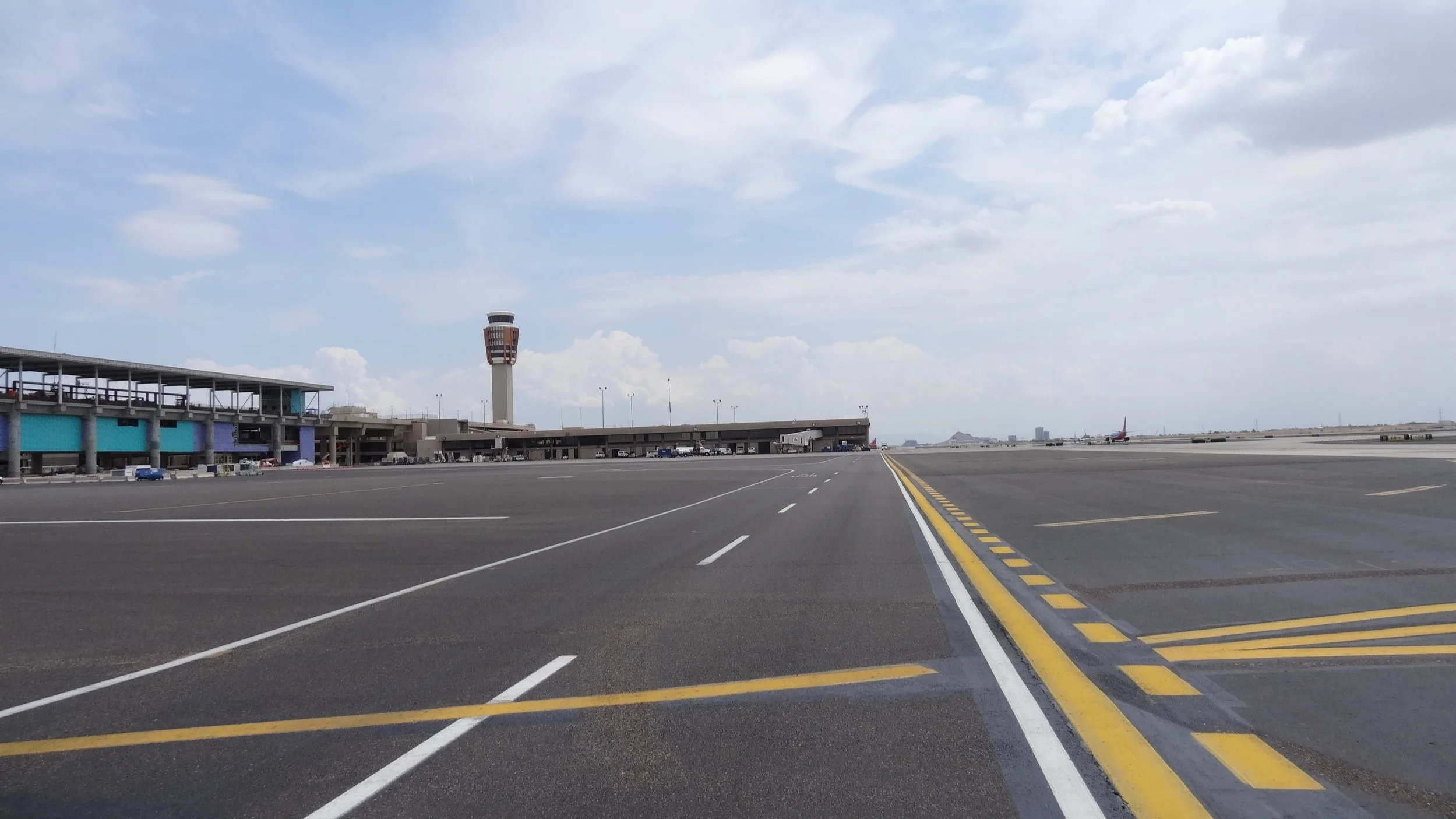
Phoenix Sky Harbor International Airport (PHX) consistently ranks as one of the top ten busiest airports in the United States and is a vital link in the nation’s transportation system. Since 2013, the City of Phoenix has relied on APTech to provide airfield pavement assessment services and recommendations. We have performed these updates in 2013, 2016, and 2019, and was again reselected to provide these services in 2022.
The primary goals of the project were to update the airport pavement management system (APMS) and to develop a maintenance and rehabilitation (M&R) plan for the airside pavements at PHX.
To accomplish this goal, we performed detailed pavement inspections in accordance with the Pavement Condition Index (PCI) procedure and conducted a simplified inspection of the vehicle service roads, reporting general conditions of each section, and estimating the timing for rehabilitation.
During past projects, APTech performed FWD testing and the associated data analysis to evaluate the properties of the pavement and subgrade layers. We referenced that testing data to determine Pavement Classification Ratings (PCRs) for the airfield pavements using current traffic data, bringing the airport into compliance with updated FAA strength reporting requirements. APTech also measured and assessed the condition of the transverse saw-cut grooves on the runways and high-speed taxiways. Using these results in conjunction with PAVER, we identified and prioritized pavement rehabilitation projects—along with associated costs—to enable the City to plan for their capital improvement needs.
In addition, APTech continued support of its web-based interactive pavement management data visualization tool, IDEA, for PHX to disseminate information, results, and recommendations of the APMS in an easy-to-access format.
As with any busy commercial-service airport, we worked closely with PHX Operations throughout the duration of field work to coordinate safe and efficient inspections that reduce strain on the airport’s operations. Although the PCI inspections were delayed for several months due to ongoing construction work on the airfield, we expedited the inspections once airside access was allowed to keep the project on track.
We understand the importance of listening to client needs and adapting as they change. Throughout almost every iteration of our PHX pavement assessments, the scope has been tailored to address the current and continually changing needs of the City and the airport. The findings and recommendations from this project allow the City of Phoenix to maintain their extensive airfield pavement network in a cost-effective manner. The City has closely followed the recommendations from previous updates, resulting in continued improvement of the airfield pavement condition.

After establishing an airport pavement management system (APMS) in the early 1980’s, the Wisconsin Department of Transportation, Bureau of Aeronautics (BOA) decided in 2009 that it was no longer utilizing valuable APMS data to its fullest extent. In addition, it was using a proprietary APMS software program that was no longer fulfilling its needs. Therefore, in 2009, the BOA selected APTech to modernize its APMS and update the pavement inventory and condition data contained in the system. The goal of this project was to maximize the usefulness of the APMS for all users of the information including the BOA, airport sponsors, consultants, and the Federal Aviation Administration (FAA). Building on the success of the previous project, the BOA selected APTech to conduct the 2012 to 2018, 2019 to 2022, and most recently the 2023 to 2026 Wisconsin APMS Updates, which now totals ninety-one airports.
Our work for this project includes:
For the initial project, converting the original APMS database from a proprietary software system to one utilizing the PAVER pavement management software
Conducting pavement condition index (PCI) inspections for approximately one-third of the state APMS each year over a 3-year period
Updating the PAVER database with pavement inventory data, construction history information, project mapping, PCI data, and analysis criteria.
Completing a 5-year pavement maintenance and rehabilitation (M&R) needs analysis for existing pavements included in the project
Developing a GIS link network definition maps to the data contained within PAVER
Assisting with the incorporation of specific APMS data into the BOA’s external GIS
Conducting structural evaluation through falling-weight deflectometer testing
Calculating pavement condition numbers, as needed, for all commercial airport runways, multiple taxiway and apron areas, and several general aviation airports in the system
Preparing individual airport reports
Developing the Wisconsin IDEA for use by all stakeholders
The APMS allows the BOA to proactively manage the M&R needs of the pavement infrastructure at Wisconsin airports in the most fiscally responsible manner possible. It provides the BOA with the means to anticipate pavement-related funding needs and provides airports with the information needed to remain in compliance with Public Law 103-305 and FAA grant assurance 11 regarding a pavement maintenance management program.

The Houston Airport System (HAS) implemented an asset management strategy to maintain its pavement infrastructure as efficiently and effectively as possible. As part of this strategy, HAS selected a firm to complete several comprehensive asset condition assessments in 2013. We were selected as a subcontractor to take advantage of the firm's extensive Airport Pavement Management System (APMS) experience. This project involved concurrent efforts at all three HAS airports and the management of large volumes of high-accuracy pavement data, structural, and other data was integrated into the HAS databases.
Our role included updating the APMS for the airfield pavements at Houston Bush Intercontinental Airport and Houston Hobby Airport. We mapped pavement distresses on the runways and taxiways at both airports. We also performed FWD testing at Houston Hobby Airport and developed Pavement Classification Numbers at both airports. We used the results to develop maintenance and rehabilitation recommendations for the runways and taxiways at the airports. We were also able to assist in the delivery of business process recommendations to HAS for more efficient management of airfield assets in the future.

The Tennessee Department of Transportation (TDOT) Aeronautics Division recognizes the need for a successful airport pavement management system (APMS). The APMS plays an integral role in maintaining the state’s pavement infrastructure at its seventy airports. As such, in 2018, TDOT selected APTech to update its APMS. This successful update led to TDOT partnering with APTech for a second time in 2022.
Throughout this project, APTech reviewed pavement related work information and used this data to update the PAVER database and network definition maps. APTech then conducted Pavement Condition Index (PCI) inspections in accordance with ASTM D5340, and the collected data was incorporated into the PAVER database. In addition, APTech analyzed distress data, performed a statewide condition analysis, developed pavement performance forecast models, and prepared a 5-year maintenance and rehabilitation (M&R) plan for each airport.
APTech also updated the web-based, interactive pavement management data visualization tool, IDEA, which enables users to easily view and retrieve project information and results. APTech delivered a 1-day training course to the Aeronautics Division staff, which included an overview of the APMS and the use of PAVER software. During the previous project, structural testing was conducted with APTech’s falling weight deflectometer (FWD) and Pavement Classification Numbers (PCNs) were calculated for runway pavements at thirty-two airports.
During the previous update and this update, the Aeronautics Division retained APTech to complete additional work orders as part of this project, including updating the APMS to modify included pavement areas, assisting with comparing state material specifications with those of the FAA, and developing a pavement life-cycle cost analysis tool. Additionally, APTech is currently assisting the Aeronautics Division with a bituminous index pricing adjustment, fuel indexing, and the standardization of specification bid items numbers.
Results have been used to assist TDOT with their annual statewide maintenance program and provide input on project selections and treatment types.

In 2002, the Missouri Department of Transportation (MoDOT) Multimodal Operations – Aviation Section (Aviation Section) selected APTech to implement an Airport Pavement Management System (APMS), beginning with a pilot study involving five airports. The project was so successful that MoDOT retained APTech to expand the APMS to include most of the agency’s paved, publicly owned public-use airports. Since then, APTech has partnered with MoDOT several times to update the APMS, including the current on-call project. The APMS now contains seventy airports. Each update is typically divided into three phases with approximately one-third of the system’s airports inspected during each phase.
APTech’s work for each project phase includes updating the systems inventory and network definition and conducting Pavement Condition Index (PCI) inspections. The APTech team also customizes the PAVER database, analyzes the collected data, and generates project reports. In addition, APTech uses the collected data to develop a 5-year maintenance and rehabilitation (M&R) program.
In 2011, APTech integrated the MoDOT Aviation Section’s APMS to APTech’s web-based interactive pavement data visualization tool, IDEA. Since then, IDEA has been a valuable resource to share pavement information in an easy-to-understand format. Consistent updates provide the MoDOT Aviation Section and stakeholders with the most accurate and updated information available. During previous project updates, APTech conducted a webinar on the use of the IDEA program for airport sponsors, performed structural testing with a falling-weight deflectometer (FWD), and calculated Pavement Condition Numbers (PCNs) for selected pavements.
APTech’s work allows the MoDOT Aviation Section to proactively manage the pavement infrastructure at its airports in the most fiscally responsible manner possible. It provides the MoDOT Aviation Section with the means to anticipate pavement-related funding needs, as well as provides National Plan of Integrated Airport Systems (NPIAS) airports with the information needed to remain in compliance with Public Law 103-305 regarding pavement maintenance management.

The State of Hawaii owns and operates the public-use airports throughout the state. Recognizing the tremendous value these facilities represent, the Hawaii DOT (HDOT) implemented an airport pavement management system (APMS) in 1999. During this initial project, APTech implemented the portion of the APMS for Daniel K. Inouye International (HNL) and Kahului (OGG) Airports. Due to the state’s satisfaction, APTech was contracted again in 2005 and 2014. These updates were split into two separate projects, one for five small hub commercial airports and a second for two medium and large hub airports (HNL and OGG). Most recently, in 2019, HDOT selected the team of Bowers + Kubota (B+K) and APTech, serving in a subconsultant role, to update the State’s APMS for fifteen airports, including seven commercial service airports and eight general aviation airports.
Throughout the projects, our work included:
Performing records research
Evaluating the airport pavements using the PCI procedure
Updating the PAVER database
Preparing a multi-year maintenance and rehabilitation (M&R) plan
Producing detailed project reports
Incorporating pavement data within the state’s WINGS GIS
During the 2000 and 2014 updates, conducting a full structural analysis of the pavements at HNL and OGG using a heavy-weight falling weight deflectometer (FWD)
Work at these airports presented some interesting challenges. Both HNL and OGG are very busy facilities. Therefore, completing the fieldwork efficiently required extensive coordination with operations, engineering, and the FAA staff responsible for controlling the facilities and their flight operations. The COVID-19 pandemic also presented a significant challenge to completing the most recent update due to state travel restrictions. However, the B+K/APTech team was able to adjust to this new reality and leveraged B+K’s local presence with APTech’s APMS expertise to deliver a successful APMS update.

For over the past 10 years, the United States Army has implemented and maintained a pavement management system for their roadways, parking, and motor pool pavements. As part of this effort, the United States Army Corps of Engineers–Omaha District has awarded indefinite delivery indefinite quantity (IDIQ) contracts with consultants who have specialized knowledge in pavement engineering. APTech is currently one of the teams under an IDIQ contract with the Army to provide pavement management services of their roadways, parking, and motor pool pavements.
Under the current IDIQ, APTech has implemented or updated the pavement management system at the following posts:
Camp Parks
Dugway Proving Ground
Fort Bliss
Fort Devens
Fort Hood
Fort Huachuca
Fort Leonard Wood
Fort McCoy
Fort Sill
The roadway, parking, and motor pools at these posts total approximately 350 million square feet of pavement. Work has included performing records reviews, updating the pavement inventory within the PAVER pavement management system, performing Installation Status Report-Pavement Condition Index (ISR-PCI) surveys, and customizing the maintenance and rehabilitation inputs for the roadways, parking, and motor pool pavements. As part of the maintenance and rehabilitation analysis, APTech creates or updates pavement prediction models, creates or updates ISR-PCI versus cost models, and performs 10-year work planning analysis. These components are used to develop a list of recommended rehabilitation projects which is thoroughly reviewed and edited during a project formulation with each post.
As part of the pavement management system, APTech is aligning segmentation of the pavement with Real Property data. The goal of this alignment is for the Army to gain an understanding of the condition of each facility as defined by Real Property data. By providing the Army the pavement condition information and a recommended list of projects for their posts, budgets can be appropriately made to allocate money to pavements in need.
Under a previous IDIQ, APTech has implemented the pavement management system at Detroit Arsenal, Fort Belvoir, Fort Knox, Fort Rucker, Fort Wainwright, The Pentagon, and West Point.

In 2007, the Canadian Department of National Defence (DND) implemented an airfield pavement management system (PMS) to assist with managing their pavement network. Although the project included distress data collection following the pavement condition index (PCI) procedures and general work plan development using PAVER, the DND soon discovered that additional information was needed to adequately plan for maintenance and rehabilitation (M&R) needs on their airfields.
In 2012, the Canadian DND recognized a need to enhance their PMS and selected APTech to conduct PCI inspections and supplemental distress surveys to adequately address and plan for their M&R needs. The contract included twenty-three airfield facilities throughout Canada, representing the Royal Canadian Air Force (RCAF), Canadian Army, and Royal Canadian Navy (RCN) and covering more than 8 million square meters of pavement. Due to their satisfaction with APTech’s work and deliverables, the Canadian DND again selected APTech in 2019 to update the airfield PMS at their facilities throughout Canada.
As part of the project, APTech conducted a records review while also updating network definition maps and PAVER databases. PCI inspections were conducted in accordance with ASTM D5340. In addition, a supplemental distress survey was conducted using APTech’s GIS-based mapping tool, in which every distress is identified and electronically mapped with GPS coordinates. Using this tool, every distress in both portland cement concrete pavement and asphalt concrete pavement that poses a safety concern is mapped. APTech referenced GIS-mapped distress data from the previous IDIQ as a starting point for current inspections. The field inspectors compared distresses during inspections, giving APTech the unparalleled ability to analyze the progression of specific distresses and the deterioration of sections as a whole.
APTech also analyzed distress data and developed recommended rehabilitation plans, along with detailed localized maintenance plans. Distress maps are used to highlight maintenance needs for the airfield pavements, which can be easily identified and repaired by maintenance forces. APTech analyzed the collected data using various budget scenarios in PAVER to assess the impact of each scenario on the overall pavement condition over time. APTech provided specific M&R requirements to maintain each pavement section above a specified acceptable condition over a 5-year period, in addition to developing and mapping Engineering Assessment ratings that account for pavement condition, friction, structural condition, and foreign object debris potential.
APTech overcame the shortcomings experienced by the DND in their initial pavement management implementation by collecting additional detailed distress data and using this same data set to determine PCIs, providing both the detailed and summary results they desired. The collection of supplemental distress data provides great benefit and allows for project-level utilization by the DND. The data provide the DND the ability to:
Visually understand the condition of the pavement without having to visit each site
Identify distress patterns
Create more accurate maintenance plans,
Convey maintenance plans to sites for execution
Make more informed rehabilitation decisions
Track distress and repairs over time with subsequent inspections
APTech has also developed its web-based interactive pavement management data visualization tool, IDEA, to display the results and recommendations in both English and French. The implementation of IDEA allows the DND to disseminate pavement information with ease throughout Canada.

The Iowa DOT’s Modal Transportation Bureau has been proactive in managing the pavements at Iowa airports since the early 1990s, and in 1997, the Modal Transportation Bureau became APTech’s first state airport pavement management client. Due to its satisfaction with APTech, the Modal Transportation Bureau continued to select the APTech team to conduct its APMS updates on several projects spanning from 2003 to 2027.
The project is divided into three phases. APTech inspects approximately one-third of the system’s National Plan of Integrated Airport Systems (NPIAS) airports during each phase, with non-NPIAS airports typically inspected less frequently. During the most recent update, APTech is compiling systems inventory information provided by the Modal Transportation Bureau and updating network definition and associated airport CAD maps. The APTech team is also completing PCI inspections, updating and customizing the PAVER database, and developing M&R plans for preserving the pavement infrastructure. Additionally, APTech is developing individual airport and statewide pavement management reports. Previous updates have also included PCN determinations for runways at the project airports.
During each project, APTech updates the Modal Transportation Bureau’s interactive data visualization tool, IDEA, which provides access to the most requested pavement management information without requiring the user to obtain and operate the pavement management system. APTech has also conducted webinars on the use of IDEA and periodically provides presentations at Iowa Public Airports Association Conferences on topics related to the APMS.

The Columbus Regional Airport Authority (CRAA) has a robust pavement management program (PMP), which they have updated on a 3-year cycle since its initial implementation in 1997. For its 2021/2022 PMP update, CRAA selected Applied Pavement Technology, Inc. (APTech) to perform pavement management services at John Glenn Columbus International, Rickenbacker International, and Bolton Field Airports. APTech also led PMP updates for CRAA in 2018/2019, 2009, 2006, 2003, and 2001.
As the prime contractor, APTech was responsible for the overall project. To begin the project, APTech reviewed records for recently completed pavement projects and used the information to update pavement network details on maps and in PAVER. From there, APTech collected pavement condition data for airside and landside pavements at John Glenn Columbus International Airport and Rickenbacker International Airport and for the landside pavements at Bolton Field. APTech lead the manual PCI inspections with assistance from a local Disadvantaged Business Enterprise (DBE) firm, who was mentored throughout the process. APTech inspected the roadway pavements at John Glenn Columbus International Airport using APTech’s Enhanced Data Gathering Equipment (EDGE) vehicle, avoiding the need for traffic control and night work on these busy public-use roads. APTech also incorporated airside Pavement Condition Index (PCI) data for Bolton Field, which was provided by the Ohio Department of Transportation (DOT).
APTech analyzed pavement condition data for all six pavement networks and identified maintenance and rehabilitation (M&R) needs. The team also integrated inventory and condition data into CRAA’s existing GIS platform. To close the project, APTech developed a report that presented the results and recommendations both for the system as a whole and by airport and network (presenting airside and landside pavements separately).
APTech worked closely with CRAA to tailor the type of data collected, the method used for collection, the type of results and recommendations assessed, and the way the data was accessed. The most recent project added GIS integration of data into their existing system, allowing CRAA staff access to the results. Results from these projects provide CRAA with current condition information and M&R recommendations to cost-effectively maintain their extensive pavement network.

Since 2008, APTech has served as the pavement management consultant for the Wayne County Airport Authority (WCAA), providing services at both Detroit Metropolitan Wayne County Airport (DTW) and Willow Run Airport. APTech served as the prime consultants from 2008 to 2016 and served as subconsultant for the 2018 and 2022 pavement management program (PMP) updates at DTW through an on-call contract, while still playing a lead role.
APTech began the latest PMP update by reviewing construction records to update the existing airport network definition maps. Our team then assessed the conditions on runways, taxiways, shoulders, aprons, and blast pads using the Pavement Condition Index (PCI) methodology and entered the data into the airport’s PAVER database. APTech’s engineers then used the data to forecast future pavement conditions through performance modeling and helped develop a capital improvement plan to cost-effectively address the airport’s pavement-related needs. APTech also completed a structural evaluation, determining Pavement Classification Ratings (PCRs) for the runways. During previous updates, APTech determined a foreign object damage (FOD) potential index for each pavement section and performed falling weight deflectometer (FWD) testing on the runways.
This project came with multiple unique challenges. WCAA has added additional pavements into the system during almost every update since 2008. Such updates require meticulous project administration and strategic thinking to create a logical hierarchy within the pavement network for data collection and management. Additionally, because of the way WCAA uses data, gate areas on the terminal apron were divided into individual pavement sections to prioritize needs and better align with the way the airport completes repairs and rehabilitation. The team also worked with the airport to avoid impacting operations by performing PCI inspections overnight using artificial lighting. The project timeline set by the airport required that APTech conduct PCI inspections during the winter in northern Michigan, which necessitated schedule flexibility by the team to work around inclement weather to stay on schedule.
The project concluded with the development of a final report, an abridged executive summary, and IDEA—APTech’s web-based interactive and user-friendly data visualization tool. By including deliverables in a variety of formats, stakeholders with various levels of pavement engineering familiarity were able to engage with the project’s results and understand the importance of effective pavement management. WCAA places a high importance on preserving pavement infrastructure, and APTech’s pavement management services allow them to proactively manage their pavement assets and make the most efficient use of their funding dollars.