
APTech’s Pavement Design and Evaluation Program: providing pavement clarity in the constantly evolving transportation sector

APTech’s Pavement Design & Evaluation Program’s Kelly Smith
We continue our spotlight series on APTech’s new program areas, today highlighting the Pavement Design and Evaluation (PDE) Program. This group within APTech brings together a strong team of engineering experts and a comprehensive suite of tools and technologies to support our clients in responsible pavement stewardship. Kelly Smith, P.E., APTech’s PDE Program Manager, offered some insights into his department’s work, the clients they serve, and emerging trends in the industry.
What does the PDE Program do and what does it deliver for our clients?
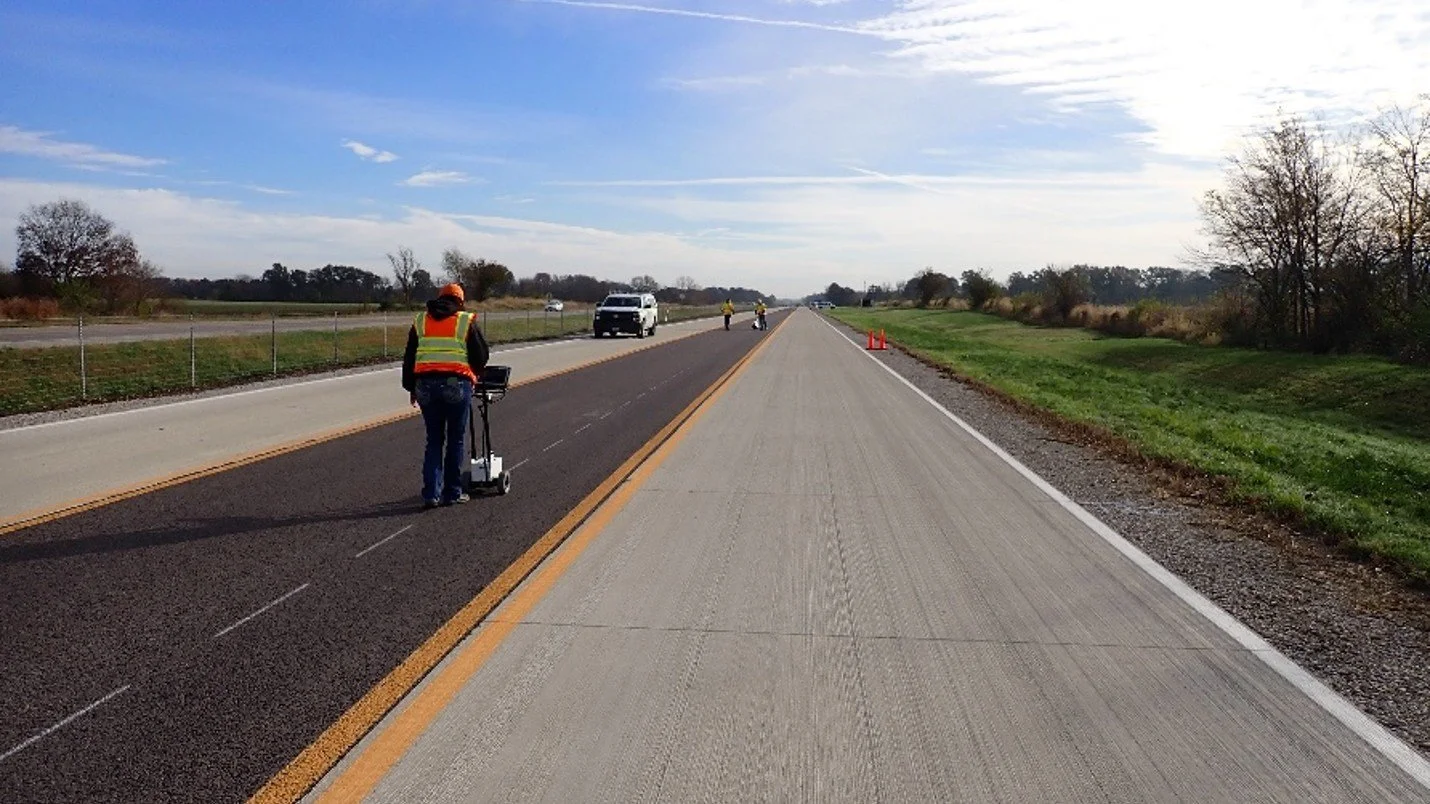
The PDE group provides a variety of services and expertise involving roadway pavement design and evaluation. Our work is manifest in two ways—real-life engineering applications and support in the development of agency practices and policies.
Engineering Applications
The PDE group performs engineering and other technical activities for clients to help fulfill their routine business practices. This work typically includes project-level evaluation and testing activities such as:
Condition surveys
Falling weight deflectometer testing
Pavement treatment strategy development
New or rehabilitated pavement design
Pavement type or strategy selection
Project reporting and recommendations
Although the vast majority of our clients are state Departments of Transportation (DOTs), we also provide engineering services for national entities, such as the Federal Lands Management Agencies and federally funded laboratories, and for local highway agencies.
Agency Practices and Policies Development
This service involves conducting research that is intended to improve processes for designing, specifying, constructing, and maintaining pavements and, as a result, the performance and cost effectiveness of their roadway pavements. Such research entails:
Literature reviews
Surveys and interviews
Data collection and analysis
Reports, manuals, and tools
Clients primarily consist of national agencies, such as the Federal Highway Administration, the National Cooperative Highway Research Program, and state DOTs.
What are some of the biggest challenges that agencies currently face with respect to pavement design and evaluation, and how is the PDE group working to solve them?
Our clients are tasked with the tremendous challenge of maintaining a vast network of roadway pavements in a good condition for the traveling public and doing so with limited staff and oftentimes shrinking budgets. Additionally, the constantly changing and ever-increasing amount of new pavement technologies makes it difficult for agencies to determine which benefit their practices and policies the most and can provide taxpayers with the biggest bang for their buck.
Through its two-pronged approach to servicing clients, the PDE group is able to:
a) Do the heavy lifting of testing and evaluating roadway pavements and identifying the most cost-effective options for the client and,
b) Investigate and advise agencies on a variety of technologies that can be adopted to help overcome pavement performance and management challenges.
As examples, the PDE group has performed numerous pavement design and evaluation studies as part of conventional as well as innovative highway contracting—like design-builds and public-private partnerships—and conducted a variety of studies involving topics like pavement surface characteristics, mechanistic-empirical pavement design procedures, and pavement type selection.

What trends are you seeing in the industry these days?
Pavement Surface Characteristics and Vehicle Response
Pavement surface properties—including profile, macrotexture, and microtexture—directly impact the safety and ride comfort of a road. Such properties are largely a function of the surface layer material, how well it is constructed, and how durable it is under traffic and environmental loadings. Accurate measurement of the most discerning surface property parameters is needed to help ensure roads are kept safe and smooth for a range of vehicles with different response forms.
Long-life Pavements
The traditional strategy for managing pavements is a serial rehabilitation approach—a pavement is initially designed and built to last 20 to 30 years and is then rehabilitated several times on a nominal interval. This approach can often be more costly on a life-cycle cost basis compared to a long-life strategy that uses a much longer design life for the initial structure followed by intermittent lower-cost preservation treatments. The benefits of a long-life strategy are particularly significant for high-type facilities where user costs associated with work zones become a major concern. A vital component to long-life pavements is a strong, uniform, and highly durable foundation layer on which the pavement can be placed.
How do you like to spend your time outside of work?
There are many different interests and hobbies that help relax and redirect my mind. These generally center around family (including pets!) and friends, sports, music, and DIY home projects.
This continues our series where we feature our five new program areas at APTech. In each installment, leaders from each department will discuss their work and their program’s place in the future of pavement engineering, research, training, and asset management.
Learn more about our Pavement Design and Evaluation work.